Showing posts with label Clive Barker. Show all posts

Tuesday, April 21, 2026

Razorline: Clive Barker's MCU!


I have a strange fascination with the Razorline series -- Marvel's short-lived line of "superheroes from the mind of Clive Barker!" The Death of Superman had been a juggernaut for the world of comics, so everyone was looking for the next big gimmick. One of Marvel's ideas was to create a universe of superheroes created by Clive Barker. I remember Razorline having a massive push behind it; Hellraiser III had a similar marketing push around the same time, so they were definitely trying to get Barker more in the mainstream at that point.

I was a horror fan and had just gotten into comics, so I had seen the heavy promotion of the Razorline imprint at comic shops and in magazines like Wizard and Hero. Long-running comics can be hard to get into, so it's nice when you can join a title from the start. I remember the Razorline comics being at my local supermarket and my mom pushing me to buy them because they seemed neat and because of Barker's involvement. (It didn't seem like her, but my mom was somehow favorable of the first two Hellraisers and was like "Ooh, they're from that Hellraiser guy!") I mostly remember having issues of Ectokid and Saint Sinner -- I liked Ectokid, but didn't keep up with it because, hey, comics are expensive when you're a kid. You have to choose wisely what you want to buy. (I wasted a lot of time in comic shops deciding on what to buy.)

Razorline's often popped up in my thoughts and, over the years, I became a bigger fan of Barker's, and that led to me checking them out again. They made such a big deal out of this and it only lasted under a year! What happened? What went wrong? SO much promotion for it! They talked of three new titles and future storylines and none of the titles cracked 10 issues! It just boggles my mind how it all went up so quickly.

I think the first mistake with the Razorline comics was to have them all share a universe. Each title was already big in scope and packed with layered mythology and were already big concepts to swallow, so by trying to link them all, it just became unwieldy and got away from the various creators. Most of the Razorline titles started out strong, but...changed, and started petering out, and I think it was when they started trying to do crossovers and link titles. But each of the titles held such promise...

-ECTOKID, written at first by James Robinson and then Lana Wachowski. I liked this one as a kid and, judging from the letters column, it was the favorite of most readers. I'll say it's my favorite of the titles, even if some of that is just because I liked it as a kid. But the Ectosphere is a cool concept (a world created by the dead who are still clinging to their lost lives) and "Deadboy Dex," the half-human, half-ghost protagonist has a memorable look, attitude and ability that helps it stand out. Dex encounters a lot of nifty monsters and creatures throughout his book, one of the most memorable being the black creatures known as the Etherites, who make sure the occupants of the Ectosphere are supposed to be there and those who aren't are moved on. Wachowski gives Dex interesting powers (even if controlling his ectoplasm looks like he's swinging around loogies) and brings more emotion to the series, but it's a shame that the title loses its New Orleans focus and flavor once Robinson leaves as writer.

Ectokid's easily the most accessible of the Razorline titles, proven by the fact that they made attempts at making a cartoon and video game out of it. Supposedly some people were turned off by the horror aspect of it when...it's not quite horror. It's horror in the way Ghostbusters is horror -- it deals with the supernatural, but it's not trying to scare you.

-SAINT SINNER, written by Elaine Lee, seems like the controversial title. I had issues as a kid, but don't remember reading them -- I probably did and was just confused by it, because it's a trip. I'm surprised it wasn't the breakout title of the bunch, because it has such a unique premise and mood that I feel like most people would have appreciated at the time, and it's the title that feels the most Barker-like to me. It's also the darkest, most horror-like of the Razorlines. But it has its own unique style to it that sounds like people found off-putting. But I think that's the point -- writer Elaine Lee and artist Max Douglas aren't holding your hand, but throwing intense fragments of information at you and you get the picture through the feel of it. It's a mood piece, and they want to convey the fractured headspace of possessed main character Philip Fetter, they want to convey the bizarre world and dimensions he travels. (The character who is a dimension hopper always being out of focus, as if vibrating and never in synch with where he is, is such a cool idea. And it was clever to have the angelic Regina's dialogue be in a calligraphy font while the demonic Runesmith's dialogue is in the style of a ransom note.) 

The artistic, expressive writing, the inventive and stylish artwork, this title is more mature than the others, and I think if it was aimed at mature readers, it would have been beneficial to the series. Razorline wasn't intended to be an imprint like DC's Vertigo or Marvel's own Epic, which targeted mature readers exclusively; Razorline was intended to be regular comics for all readers. I think they could have easily dusted this one off for a Rated M revamp. The premise of the titular character answering prayers of the downtrodden holds a lot of story potential, even if some risked the chance of being episodic. It's a dark (with dark humor), twisted, moody, atmospheric and visceral read that sticks with you. I admit that a lot of it is confusing, but I still think that's a stylistic choice and that it's going more for a mood.

-HOKUM & HEX, written by Frank Lovece. I don't think I bothered with this one at the time, and I was hesitant to read it now because I thought it was going to be dopey. But it had a lot of cool ideas and is well-paced. The big stand out is the main character, Trip Munroe, who's a unique superhero in that he's a depressed, traumatized guy who's also a bit of a flop in life, but is somehow given magical, god-like powers. (Despite that description, he's a stand-up comedian!) So we follow him along as he's bungling his way to being a superhero, not wanting the responsibility, but he starts to better himself and, as the series wraps up, he finds that maybe being a hero is the one thing he could be good at. This description doesn't do the comic justice; it makes it sound like Trip's a Tick-like cartoonish dummy when he's more grounded and nuanced and pathetic. Lovece describes Trip as a talentless loser. I can't think of another hero like him in American comics -- this failure who's somehow supposed to be "Earth's Champion" -- these titles sharing a universe kind of undercuts Trip's unique situation.

I didn't care for some of the designs in this one, though -- mainly the troll-like Corpii, which I don't think fit in with the rest of this title's style. Some cool looking villains with Felon Bale and Bloodshed, at least. (Felon Bale should find some pants, though.)

-HYPERKIND, by Fred Burke. A superhero team with cool designs (my favorite is Logix), I like the Egyptian inspiration of their powers, the history of the previous team, that the modern version is a bunch of flawed L.A. street kids who don't get along so easily is an interesting angle. I feel like this title deviated from the original plans somewhat -- in that preview issue, we're told the previous team's downfall was their in-fighting, and that the new team would have to prevent history from repeating. But the actual comic shows us that the original team was all pretty much taken down by the villain's manipulation of them. We're also told the old team is all dead, but they'll keep popping up (still, mysteriously) alive when the story calls for it.

The new incarnation of the team also vows to fight for the disenfranchised people of Earth, but they're quickly swept up into fighting supervillains, so these heroes who have been hardened by life on the L.A. streets ends up abandoning their vow to fight for people similar to them. That was the series' unique hook, in my opinion -- superheroes for the disenfranchised.

The heroes of all of the Razorline titles are flawed, which is refreshing, but Hyperkind takes it a little too far and the heroes come across a little unlikable to me. (Especially Lisa, who the book focuses on. A spoiled rich kid who doesn't relate to her so-called friends and does nothing but complain about them and her situation and everything.) Having one team member be a part-time drug dealer and another being a stripper/prostitute/addict is certainly a surprise for a comic aimed at all readers -- it's nothing compared to how extreme comics would eventually become, but still a shock for the time.

Yeah, Hyperkind is my least favorite of the Razorline. Perhaps I judge it more harshly because I like superhero teams. Or perhaps I prefer Marvel's Generation X, which came a few years later, but reminiscent in that it's also about angsty, lost, very '90s teen heroes trying to get along. Generation X might not be as edgy as Hyperkind, but it's a more entertaining read. (Actually taking breathers for issues with the characters just interacting; not jumping from one crazy big scenario and conspiracy to the next.)

The keywords for Razorline are "unique," "imaginative," "bold" and "experimental." I think all of them were just too big and too weird to really catch on; some of the titles that have pacing issues or retcons or abandoned threads are obviously trying to course correct as they went along, but it didn't save them. Would it have been better to launch one title at a time? Were they too ambitious, too weird? Did DC Comics sabotage them?! Was it all a money-laundering scheme?! How does such a big, bold experiment -- from one of the most popular writers, from one of the biggest companies in comics -- fizzle out so quickly?! Canceled, dropped out of the blue, with storylines just getting started and being cut off without warning until the penultimate issue. The editorial page kept talking about future issues and storylines -- down to details of a crossover leading to a romance between characters. (I'm assuming, based on a group photo in issue eight of Ectokid, that the romance was to be between Saint Sinner and Hyperkind's Bliss.) So how far developed were they with these titles before the sudden cancellation? Is there lost issues in a vault at Marvel somewhere? If not issues, then scripts and artwork? How far did they get into the fifth and sixth titles, Mode Extreme and Wraitheart?

Razorline came on to the scene bold, bright, but quickly faded out. It was such a strange, unique experiment, producing strange and unique superheroes. Sometimes high concept ideas don't hold longevity -- were these titles doomed to a short run? Would they hold the same fascination and mystique for me if they went longer? It would be nice to get these titles reprinted in trade paperbacks, but I guess only the biggest Barker fans remember them. The comics themselves were as flawed as their heroes, but at least they were something different.

Wednesday, September 3, 2014

Horror comes to GSN's Skin Wars

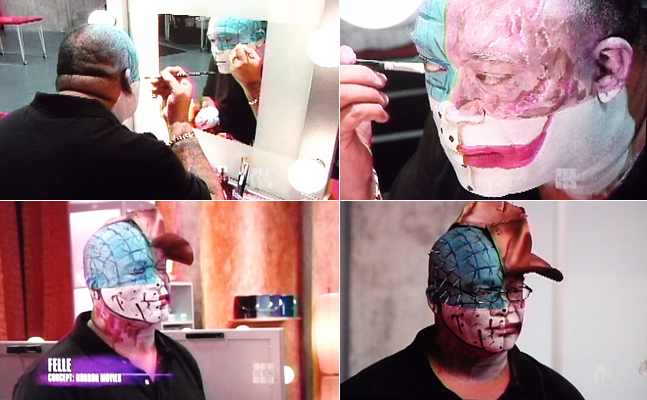
The Game Show Network has a new series, a body art competition show called Skin Wars. The competing body artists are given themes to work with each week and the last episode challenged the artists to make themselves up as one of their big fears. (They usually paint models, but an extra part of this challenge was for them to apply the make-up on themselves.) Some of the artists did things like aging and arachnids, but artist Felle chose horror movies and came up with...


I just got a kick out of this. Part Freddy, part Pinhead. (There's also Heath Ledger's Joker and...I don't really recognize the other part below Pinhead.) Hellraiser always seemed to me like it's not on the radar as much as a Freddy or Jason, so I always like when it gets referenced somewhere. (As it did on a Community episode last season.) The artists on Skin Wars are given a couple of hours to complete their projects, so I think Felle's Pinhead and the Freddy burns turned out nicely. (These pics I took don't do it justice.)

Friday, August 29, 2014

The Hell Tale Heart


Since toy companies like to ignore the majority of non-monster characters from horror movies -- especially the heroines -- I've once again taken it upon myself to make another custom figure in my Horror Heroines line. This time it's Hellraiser's Kirsty Cotton. For a while there, I considered Kirsty to be my favorite Horror Heroine. (I'll get to the reasons why that changed.)

I got into the Hellraiser movies big time in 2003. I just wasn't into Hellraiser much when I was younger, and hadn't watched a movie beyond the third one -- and it's memories of that third one that negatively influenced what I thought of the series until I decided to give them another chance. I was pretty damn surprised at how much I ended up liking the first one after revisiting it; it's a smaller scale horror movie, about adult characters and for adult fans.

Monstrous human characters are the movie's major villains -- the over-the-top Cenobites are just supporting players. On one side, you have Frank Cotton -- a walking embodiment of the seven deadly sins -- and Julia Cotton, his sister-in-law who's rotted from an unhappy marriage and is blindly manipulated by Frank into becoming a monster for him; killing for him to get him back seemingly resuscitates her and makes her more alive than she's seemed for quite a while. On the other side, you have Larry Cotton, who's just a poor, but well-intentioned schlub, and his daughter Kirsty, who wants the best for her father. (She has pretty much seen through Julia all along.) Larry ain't stupid: he senses Julia's unhappiness which is why he decides to move to her "home turf" in England, which is a strange city in England that can't quite tell if it's English or American. (Other than Julia, accents come and go, and cops have guns in the sequel!) I feel there's a definitively clear black and white, good versus evil represented by both duos. I know Clive Barker's more interested in shades of gray, and I think Julia is a bit more complicated than being a flat-out villain (she begins her descent into madness out of a misplaced sense of love). And she definitely has shades of gray, but Frank is total scum. There's *nothing* likable or redeemable about him.


Kirsty benefits from being an older character than typical horror heroines -- she's obviously around college age, at least in her early 20s and not mid-teens like the norm. She joins her dad in England, probably to keep touch with him. (And keep an eye on Julia?) Right away, it seems like something is after her: she begins to dream premonitions and is followed by the homeless man, who is later revealed to be a watcher of the puzzle box. It's checking up on Julia that gets her pulled into the web -- she hears screams come from the house, but she doesn't flee, she investigates. She finally, finally is about to get confirmation on all she's probably suspected about Julia, and she finds...Frank. She's justifiably terrified, but she stands her ground and fights Frank back. Kirsty's courageous and in a believable way, I find. There's a lot of horror movies that are trying to portray such a positive image that the protagonist is nearly superhuman in their strength and resolve. For example, I think the Scream movies are pretty bad about that. Sidney goes through and does stuff that would probably kill Wile E. Coyote, but will be on her feet in the next frame, her senses sharp as only a screenwriter could make them. Sidney should be with the Teen Titans, you know? Kirsty can fight and keep her senses, but not to a cartoonish degree like that.

You get the sense that she's the first person to even think of talking to and trying to deal with the Cenobites. Well, she at least seems to be the first person that tried that with Pinhead. She puts it all together, realizing Frank escaped them, and promises to lead them to him in her place. When the Cenobites seem to go back on their word, after dealing with Frank? By that point, she's through with this shit. She sends 'em back like *that*. (Watch for that funny scene when the Engineer enters the front door and Kirsty's milksop, Larry Appleton-looking love interest tries to take the box from her and she just punches him out of the way. It's hilarious.)

Kirsty really shines in Hellraiser 2, though. Her goodness, her pureness of heart leads her to...willingly walk into hell to save her father! And not only does it end up being a trick by Frank to lure her to him, but she has to contend with a more powerful Julia and the even more powerful Channard Cenobite (who's so powerful, he disposes of the four Cenobites in no time), while racing to prevent the dimensions opened by the puzzle boxes from merging with Earth. Not only that, but she has to play guardian to Tiffany. And not only that, but she tricks Channard and saves Tiffany...BY PUTTING ON JULIA'S SKIN! That's dedication, man. Meanwhile, Ginny's practically dry-heaving at putting on Jason's mother's moldy sweater in Friday the 13th Part 2. Amateur!

Hellraiser 2 saw Kirsty and Tiffany exiting the asylum, maybe finally free and clear of trauma, but ready to go kick some Cenobite ass in future installments, right? Not really. Kirsty's reduced to a lame VHS cameo in Part 3 and then forgotten about until the sixth movie, Hellseeker, a lame and lazy rewrite of another script that decides to shoehorn a character named "Kirsty Cotton" into the script, only the character isn't Kirsty Cotton. The Kirsty Cotton I know wouldn't be some petty sneak who opens the box just to get back at her shitbag husband, then talking Pinhead into letting her kill her husband and his mistresses for him instead of the Cenobites taking her. This is Kirsty, who attempted to pull her dad out of hell. This is Kirsty, who wore another woman's skin to save someone.

Look, it's bad enough that Hellseeker is an abysmal movie that feels three hours longer than it is -- did they really need to make Kirsty into a villain? Into someone more like Julia, a person she despised? And while one of the things I find interesting about Pinhead is that he's willing to LISTEN to people, he doesn't just hack and slash them, do you even buy that he'd go for Kirsty's insane deal? At that point his "good friend" (as Captain Elliot Spencer referred to Kirsty in Part 3) had shown signs of being no better than someone like Julia -- I think the Cenobites would have taken her. I'm sure the Hellseeker writers are under the belief they made Kirsty "real," "flawed," or "complicated," or like they had a great twist, but they were way off the mark -- it wasn't Kirsty.

That's the last the movies saw of Kirsty, or the so-called Kirsty. But wait! There's hope yet -- Clive Barker decided to write comics from the BOOM company that ignored every movie after Part 2. It was going to be the definitive showdown of Kirsty versus Pinhead. Great, ignore the sequels. Please; a lot of them are bad. Surely -- surely! -- Clive could somewhat save Kirsty's image, right? (I say "somewhat" because, in the back of my head, comic spin-offs don't count as much as a movie installment.) Clive has supposedly said he liked Hellseeker, which I don't understand, so I shouldn't have been surprised to see that he didn't quite save Kirsty's image. In the comics -- which probably make more sense if you read them while on acid and cocaine and Hawaiian Punch and Holy Fuckin' Shit from 21 Jump Street -- Kirsty has this insane anti-logic where she thinks if she becomes a Cenobite, she can reunite with her dead loved ones, so...she willingly switches places with Pinhead, who pretends as if he wants to be human again, but really has some bonkers Dr. Doom scheme secretly planned.

So, Kirsty becomes a female version of Pinhead and, since the comics make no sense and seem like they were written on the go, she forgets all that junk about her loved ones and instead decides to let people summon her with the box and she uses that to weed out sickies and/or variations of the Lament Configuration. In the meantime, she also finds out that Cenobitin' ain't easy. And she's repeatedly tricked by a variety of different characters. And she ends up just doing nothing much but seeming stupid -- she gets trapped in a box and the day has to be saved by the Female Cenobite, Harry D'Amour, and Elliot Spencer's handicapped, octogenarian, born-of-incest daughter...or some crazy shit like that. What...the...fuck. Even Takashi Miike would find these comics weird. Long story short: Kirsty's image is still marred.

Where's the brave heroine? The one who fearlessly fought off Frank. The smart heroine, who put together just what all of that crazy Cenobite stuff was, who solved the mystery of Pinhead's identity? Barker's novel from which Hellraiser is based is called The Hellbound Heart; while the film makes some changes from the novel, it's essentially the same. (One wise decision: making Kirsty Larry's daughter; it involved her in the story more, made her more important. In the novel, she's just a mousy co-worker of Larry's who's interested in him and snoops around the house when Julia's doing her killing.) Kirsty in the book and first film is pure of heart. It's all motivations of the heart. The two with the poisoned hearts get what they deserve. Kirsty, with the pure heart, looking out for the best interest of others, is who wins.


I think actress Ashley Laurence really kicks ass and does a great job as Kirsty. (And even though I think the "Kirsty" in Hellseeker is some character from a bad Silk Stalkings episode wearing the skin of Kirsty Cotton, Laurence is still good in that movie.) Laurence seems like a strong, take-no-crap kinda woman in real-life, and that really comes through in moments where Kirsty's standing up to these hellish monsters. Laurence also didn't mind getting dirty for the role, really having maggots dumped onto her in that scene in the first movie and being covered with blood at the end of Part 2.

Since I think Hellraiser 1 and 2 go nicely together, I wanted the figure to represent both movies. Her outfit's based on her look in the first movie, but accessories pertain more to 2 -- the Spencer photograph and...Julia's skin! I just knew that had to be part of the set. And here's the result:


Front and back of packaging.

Thursday, July 25, 2013

The Detective in the Dark


Clive Barker always seems like he has good intentions and wants to do new things with horror films -- from wanting Julia to be the star of Hellraiser, giving slasher movies its first main female antagonist, to having a starring monster played by an actor of color, who represents urban legends, to trying to create a horror/fantasy hybrid described as the Star Wars of horror to creating a franchise around a horror hero rather than villain and so on. In the case of Julia, Pinhead stole her spotlight. Candyman had some success, but died a sadly quick death in direct-to-video land. The "Star Wars of horror," Nightbreed, was butchered by the studios until everything that was unique about it was gone. And the horror hero? Was introduced in a bizarre movie that people couldn't make heads or tails of. It's the horror hero I want to talk about here, the private detective Harry D'Amour.

Harry has appeared in a handful of Barker's stories -- his first appearance was in the short story "The Last Illusion," from The Book of Blood series; it was this short story that Clive chose to turn into the character's first feature film debut, "Lord of Illusions." One of the things I find most interesting about the idea of the Harry character and his world is how Clive's idea was to mash up horror and film noir; Harry's a hardboiled private-detective who always gets mixed up in terrifying supernatural cases because, to use a favorite phrase of Clive's, Harry is "paying off a karmic debt." Harry's a magnet for darkness and he doesn't know why -- all he knows is he doesn't like it. He's remarked about how much he misses mundane cases like tailing cheating spouses and investigating insurance fraud. Now, I'm a fan of hardboiled police stories, so I find this combination with horror pretty cool. Harry shares a lot of the common traits of the typical hardboiled P.I. -- the cynicism, the isolation, being burned out, being a damaged loner, haunted by cases gone bad -- but the horror elements gives him an additional weight and casts a unique light on him. He can literally be haunted by cases, and he mainly tries to distance himself from people not out of misanthropy, but because he doesn't want anyone to be affected by the things that target him. Harry seems more caring than a lot of the typical hardboiled detectives -- he's spiritually sensitive and fears for people, but he also fears for himself. Harry's tattooed with protection symbols and is religious, wearing a crucifix, crossing himself and saying prayers to victims he finds. (He's also open minded about religions other than Christianity, stating that one "can't have too many saviors.")

While I enjoy the movie "Lord of Illusions," I think it's very flawed, and not necessarily the scariest story that could have been told. (I find it goes more for being unsettling rather than going for scares.) Other than a brief scene introducing Harry early in the movie, in his home turf of NYC, it doesn't quite have the hardboiled or noirish feel, and I think it's overall inferior to the story it's based on, "The Last Illusion." Clive adapted his own story and directed the movie, so why would he change it around so much? The short story has the same model of a lot of hardboiled books, where Harry's assigned an odd, but seemingly small case that just spirals out of control, getting worse and worse. In the story, he's hired to stand guard over a magician's body until it's able to be cremated. Why is that important? Well, it turns out that the magician acquired his powers through demonic entities and, not liking the way he put those powers to use, demons are sent to claim his body. Harry's supposed to make sure the body is kept safe until it can be cremated so that the magician will be spared the eternal torments of the demons. The magician's widow found out about Harry based on news reports she saw of him, an exorcism he was involved in that went bad and generated bad publicity -- he still hasn't gotten over it and he hates to talk about what all went down with that case, which is a mystery that Clive gradually unfolds over the course of a few stories.


Now, other than Harry's character and the names of supporting characters, pretty much everything is changed for the movie! The movie's plot is the magician's wife hiring Harry to look out for her husband, who has ties to a cult leader who is trying to be revived by his remaining followers. The movie has its moments, and I think the casting is pretty good, but I thought the short story was just more interesting and more in line with the intention of the world Clive wanted to create for this character. The movie doesn't quite match up with his intentions, it's a bit odd and doesn't quite gel, and I wouldn't say it was the best way to try to kickstart a franchise. But I think there's just so much potential with the Harry character, I really like the idea of the character, so that potential is what I like about the movie. I know some people have questioned Scott Bakula's casting as Harry, not thinking he fits the role of a hardboiled tough guy, but like I said, Harry's not quite of the typical hardboiled mold. He's seen shit that would turn Mike Hammer white! Harry can beat the shit out of some two-bit thug with the best of them, but his encounters with supernatural cases have brought him a kind of weariness and -- this is important -- compassion. He doesn't like his fate, but he wants to do what he can to protect people and balance the good. So, I think Bakula works, and I like him in the role. I just think a lot of the problem is that it feels like the movie doesn't focus enough on Harry as a person, just his investigation. (It would have probably been wiser to have his film debut center on the exorcism case that's crucial to shaping the character.) Clive seemed to really like Bakula's casting, even making remarks that he's since envisioned Bakula when writing the character, and Clive doesn't BS. So, Bakula was good to base a figure of Harry of off...

Generally, horror fans don't speak well of Lord of Illusions. So...I can't imagine a company ever, ever making a Harry D'Amour figure. You think a Laurie Strode figure is impossible? No, a Harry D'Amour figure would be even less likely. You'll probably see a a box-set of Ethel and Junior from Friday the 13th Part V before a Harry D'Amour figure. Now, I'm no toy customizer. There are people out there who can do crazy-awesome stuff -- sculpt, repaint. My approach is much lazier. Luckily, thanks to Star Trek, there are figures of Bakula out there. But Harry never wears a crazy space suit, so...I looked and looked for a figure, matching the same scale, that best resembled something like Harry -- or at least a private-eye -- would wear. A simple head swap, and this is the result...


I think the character has such potential, I could easily see him being the center of a HBO or Showtime-styled series, a 10/12-episode long season, with a serialized storyline, one major case to serve as an ongoing arc per season. What also sounds interesting, though, is that Clive's been working for several years on a novel in which Harry is hired to retrieve a person who solved Lemarchand's puzzle box -- meaning Harry would be facing off against Pinhead! Some fans question whether Barker will ever finish it since he's been working on it for so long, but a lot of fans are interested in what Barker has said will be Pinhead's last appearance (as far as he's concerned). I'd also like to point out how I think Harry's a bit similar to John Constantine, and both characters were created around the same time, so I wonder which came first. (I prefer Harry more, to be honest. I've read several Hellblazer comics and enjoyed them, but Constantine can come off as a little too self-righteous. Harry's a regular guy, just tryin' his best. Harry's flawed and damaged, but does manage to have a sense of humor.)